- Tuning the Guitar
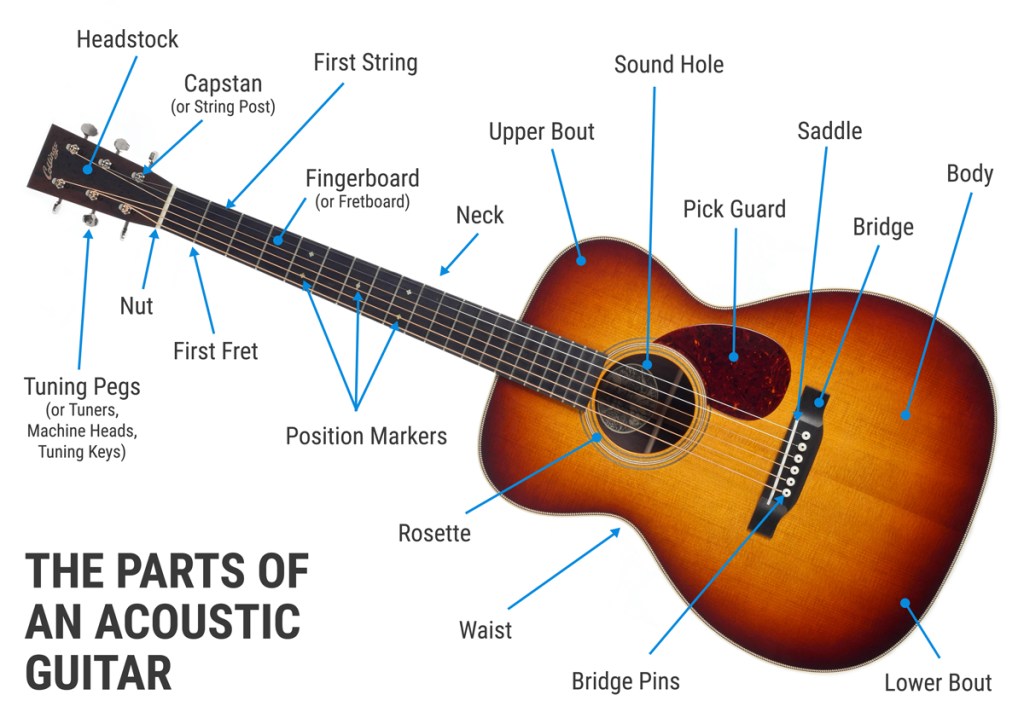
- Guitar parts
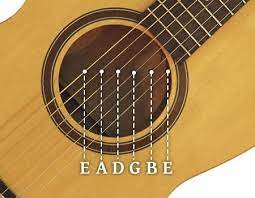
- Notes on the Strings
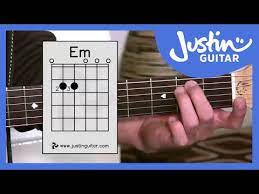
- Chords – Em, E, E7, C
Here is the video we made. Below are notes and other images that you can review
Tuning
Just going through each string using a source that helps you hear the sound, so you can match it. https://www.youtube.com/watch?v=jJxRjWtwmEE
With a Tuner – Tuners are simple and accurate, they hear what you play and then tell you whether the note is too high or too low (technically speaking – too sharp or too flat).
String to string – For most strings, the note on the 5th fret is the same as the “open” next string. The exception to this is the 3rd string (G) where the B note is on the 4th fret.
“Open” (another term we didn’t mention) means that you are playing the string without holding down any frets. Also remember that strings on a guitar are denoted one through six, starting at the bottom, so the thinnest string on the bottom is the E string or first string. The second string is the B string, the third is the G string, the fourth is the D string, the fifth is the A string and the sixth is the E string again.
Parts of the guitar
This diagram has everything we talked about and a few things that we didn’t (and one or two I didn’t even know!)
Notes on Strings:
First lets remember the notes of the strings: strings on a guitar are denoted one through six, starting at the bottom, so the thinnest string on the bottom is the E string or first string. The second string is the B string, the third is the G string, the fourth is the D string, the fifth is the A string and the sixth is the E string again.
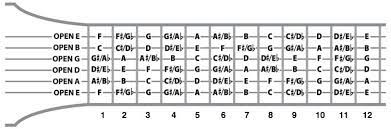
Now that you have the notes of the Open strings, you should practice learning the notes on all the strings. Remeber this is journey not a destination. Try to do this as often as you can. If you do it once a day, every day, it will take weeks or months to memorize (if you are like me), so don’t kick yourself.
In the video we did not include sharps and flats, but we did talk about a very important concept of whole steps and half steps. This is a piece of music theory that applies to every instrument, not just guitar. Each instrument deals with whole steps and half steps in it’s own way. We will use the C scale as an example because the C scale is the only one that doesn’t have any sharps or flats in it. They are all whole notes (not to be confused with whole steps!).
The notes in the C scale are:
C, D, E, F, G, A, B
There is a: whole step between C & D, a whole step between D&E, a HALF step between E&F, a whole step between F&G, a whole step between G&A, a whole step between A&B, and a HALF step between B&C.
Every major scale regardless of key follows the same pattern Whole, Whole, HALF, Whole, Whole, Whole, HALF – oke enough theory.
THE MAIN THING TO REMEMBER IS THAT EVERY FRET ON THE GUITAR IS A HALF STEP! And on every string, you will encounter every note, so remember there is always a HALF step between B&C and a Half step between E&F, every other note is a whole step, or two frets.
So, on the E string, since there is a Half step between E&F – E is the open string, F is putting your finger on the first fret. G is a whole step, so it is two frets up from the F on the third fret. The A note is a whole step, so is two frets up from G on the fifth fret.
Chords:
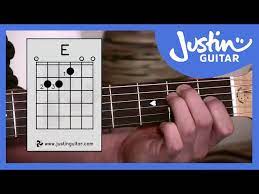
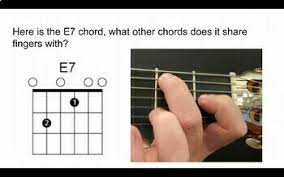
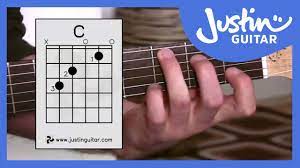
We covered the E minor, E major and E seventh chords. Plus, the C chord You will see minor major and seventh’s designated like this: Em, E, E7, & C.
Whenever you encounter music online specifically for the guitar, you may also encounter chord charts that help you remember how to play a chord, or let you know how to play a chord you never encountered before. I found these images of the chord shape on the guitar with the corresponding chart embedded so you will understand:
 Guitar Lessons